

Home
and how to read it.

An extract, edited, from my self published book of five years ago. When I was working things out. Just an observation on my local. All photographs are from my meanderings over the past few years.
There’s a phase shift that happens when you step onto a beach. Sudden, and elemental. Solid land becomes fluid sand. The shore, a place of flux, slave to tides, swell and weather, threatening to become part of the sea, oft-times in an instant.
The experienced know the rhythms. A low swell day with a change in the timing and volume of the surge can keen the blade dividing relaxed and running. On those days when watery violence is being done, just the ocean-tone can be enough to avoid a soaking, or worse, from a wall of water booming up the beach.
Like reading an animal track, there are signs. Signs of incoming, or outgoing tide, of swell size – days, hours or minutes past, and, if you are of a geological bent, those same indicators lie in the cliff faces dividing bays and indents, all along the coast.
Quiet, catastrophe, and calm, eons of weather and swell, all can be read in the rocks.
To the inexperienced, though, it is often a place of seeing without understanding. It is all just ‘the beach’, or ‘the sea’ – that big watery thing out there. To be seen but not experienced. To be feared and not embraced.
Of course these infrequent visitors often visit with joy, the experience all the more wonderful as it is an immersion in the unfamiliar. Not necessarily a literal immersion, as just the sight, smell, and immensity of the sea can be enough to bring at least a smile to the oceanic novice.
Picture this young man, high on ‘something’, who ran down the steps at Bells, dropped his shoes on the WET sand, and proceeded to stand in front of a fearful shore-break during onshore conditions and a ten-foot swell, with not a glimmer of understanding of what surrounded him.
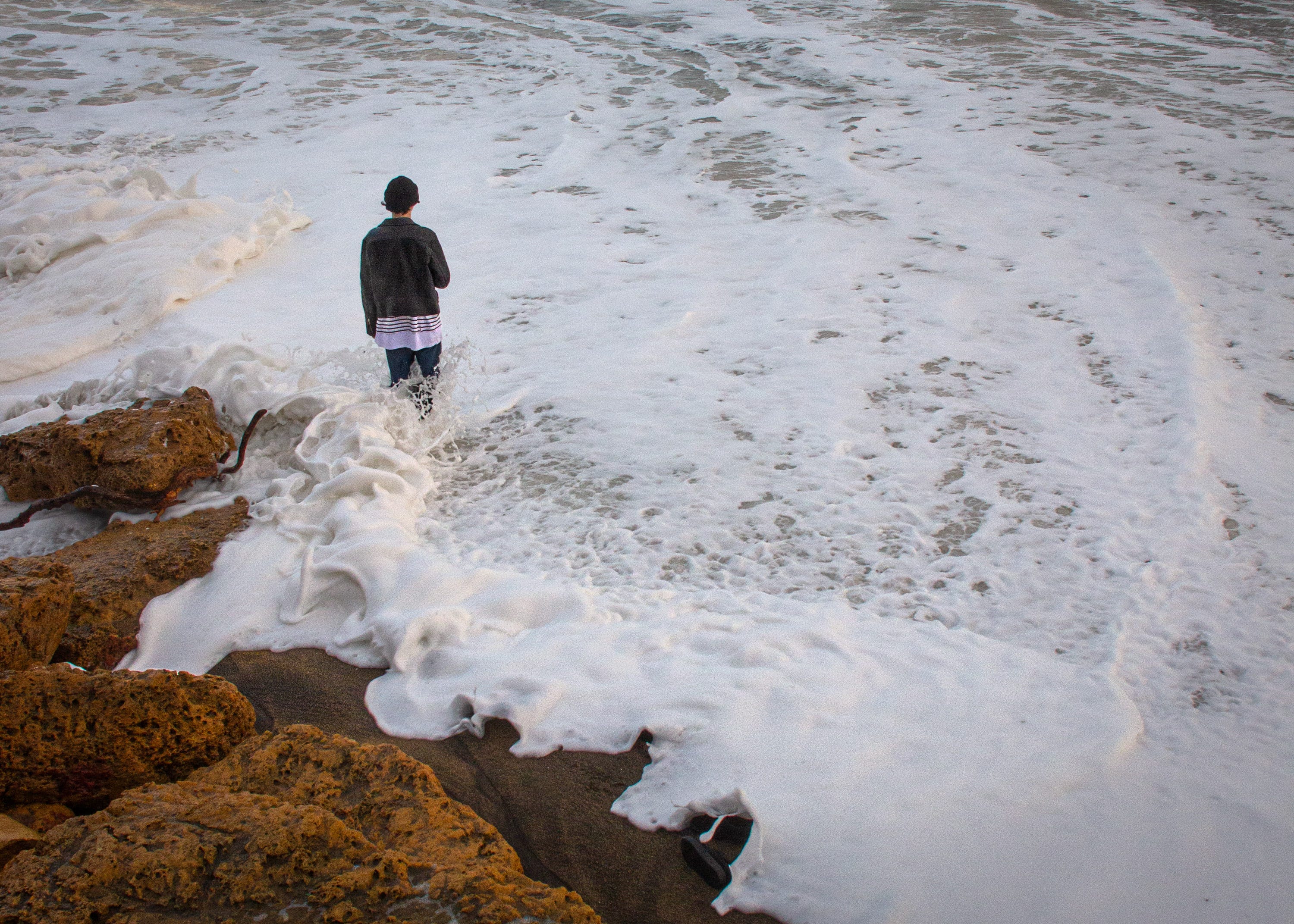
Moments later, he was up to his knees and his shoes were gone.
A little about water…and luck.
Most of the water on Earth predates it. Given there is an approximate 10 billion year gap between the Big Bang and the birth of the Earth, it is a fair bet that the ‘molecular’ age of the waters of the Earth is between 3 and 10 billion years.*
On Somewhere’s far away, storms rage and waves break on titanic scales, circling huge, rocky planets with vast oceans, deep, and shoaling. There will be shores formed to create waves breaking with such perfection that eyes gifted to see them, in ‘that certain way’, would weep with joy.
Scale and circumstance are the great frustration. The likelihood is that most, if not all of these myriad water-worlds are either sterile, or filled with lives oblivious to the joys of gazing out on a late afternoon sky, bathing in the light it brings to a coastline roaring with riches for the wave-riders far away on a blue and crowded world.
Where scale comes in too is — we will never know. There are parts of the universe so far away that the light will never reach us. Universal expansion, a now confirmed concept first mooted by astronomer Edwin Hubble, posits an expansion rate greater than the speed of light, rendering more of the universe than we know unknowable, and unreachable, in any way known, or likely.
These regions are still linked to us, though, through a common origin in that singularity that birthed our shared existence so long ago. Surging out, the newly formed reality that eventually became ours expanded at speeds beyond light, as it continues to do, though the physics within obey the rules in that strange, paradoxical dance between the Newtonian of ‘home’ and the Einsteinian of space-time.
What all of this has to do with a coastline at the bottom of a continent called Australia is as simple as this: without all of this happening exactly the way it did – one slight variation in what was, and all of this, and we, might never have existed.
Pointing this out is not a salute to predestination or a higher being. It is just the way things worked out.
And somehow, this universe, with all the time in the world, worked out a way to think. It may have done it many times, in many places, or it may have done it once.
The evolution of consciousness, though, is only a fraction of the story. Sentience manifests itself in its continuum towards the contemplative and the curious. And later that deep emotional response to a location, now known as spirit of place.
Spirit of place has complexities. To the First Nations, it is deep-seated. Being born to a place with connections even four or five generations back it is, of course, meaningful.
Knowing that the land you walk has been walked by your people for a thousand generations, where your ancestors walked in Roman times, in the times of the Pharaohs, and even in the times when those ancestors were possibly the most distantly traveled group in all mankind, – that spirit of place, and weaving to the land, is unassailable.
One late afternoon I was sitting on the rocks, with my camera, in the western corner of Bells, just above the line of an almost full tide. The afternoon light that drives through the valley illuminated the shore-break, while dark sets in the shadows of the Bells headland, and the cliffs bordering Winkipop, loomed behind.
A mixed group of mostly local surfers were out at ‘Rincon’, the name Bells assumes when there is a smallish swell, and high tide. Then, the break begins to resemble, rather inaccurately, the fabled Rincon Point in Santa Barbara, California.
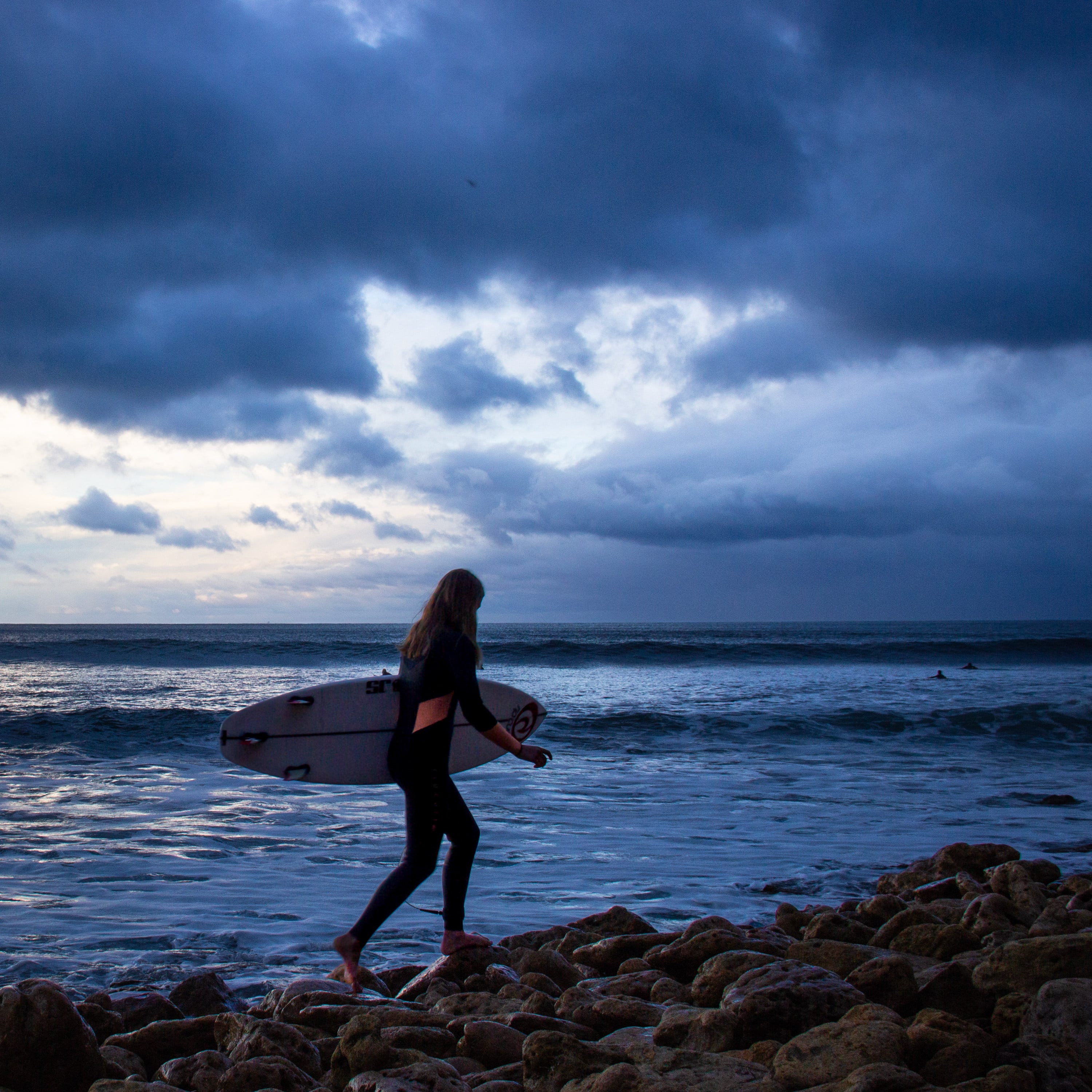
Our Rincon can be a long, varied, fun wave, suited to all kinds of craft, and ages. This day was that, not too crowded, with fifty years sharing the lineup. Most were competent to excellent surfers, the youngest amongst them a minute seven or eight-year-old, completely at ease in, (for him, or her, as nowadays it is difficult to tell) the double overhead waves.
A visiting sporting team, in uniform tracksuits, descended the steps to the beach. Young men around twenty, phones out, taking snaps, laughing, new to this place. The shore-break was big enough to warrant my keeping an eye on them, as they were clearly not, as a group, ocean-aware enough to avoid at least a good splashing from a misjudged rush of Southern Ocean.
One of the guys laughingly stripped down to his shorts, posed in front of the group in a pre-swim swagger, and was promptly joined by two more champions. I’d not been taking too much notice as I had my attention on the surfing, but when they went in their safety had my radar up, though the dunk was swift, the water being a brittle 12C.
As they exited the water, that late in the day knife of light hit them, and I swung around to snap off one shot.
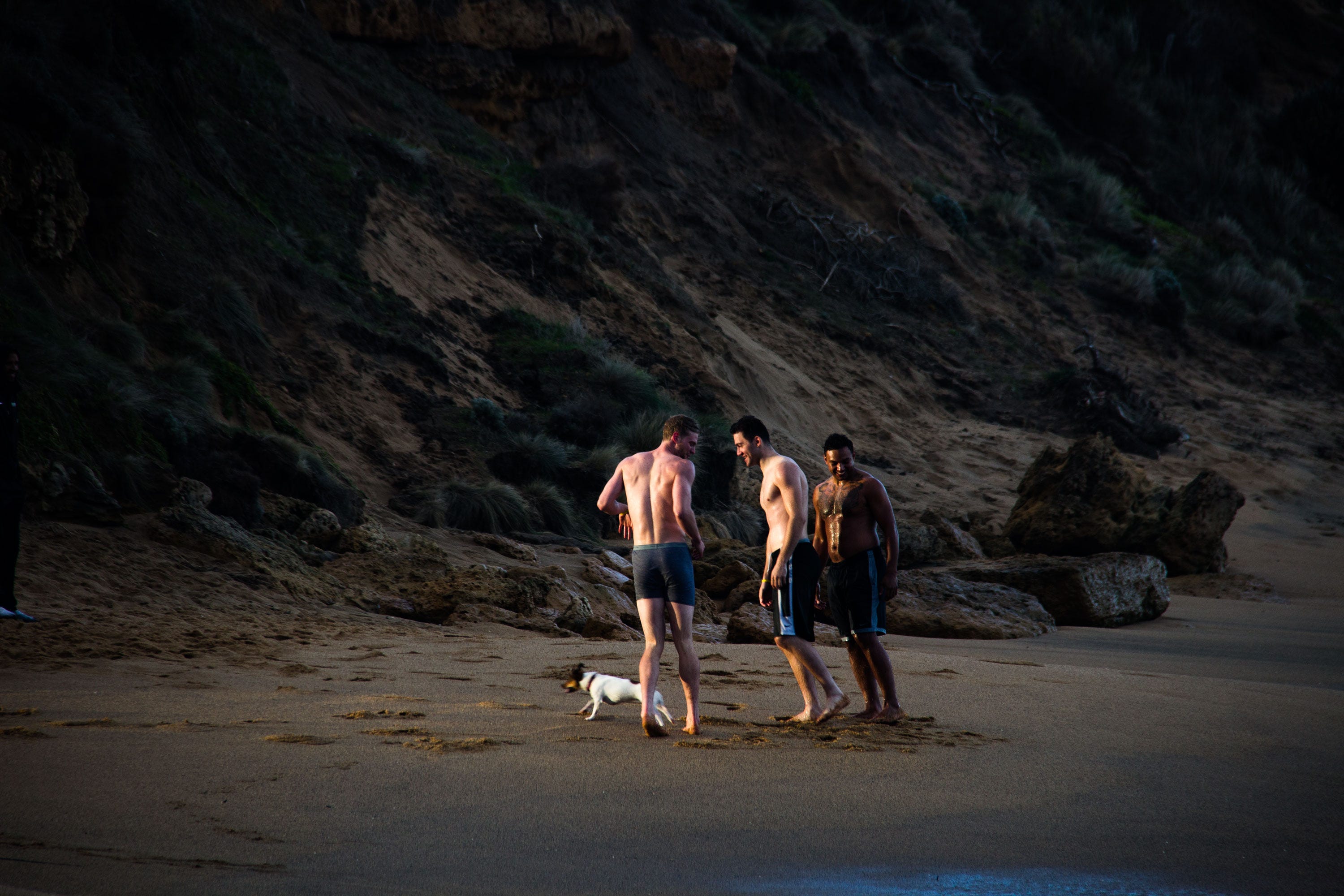
Later I realised I’d captured one of those moments. A lifetime memory formed, when you know that at the end of their lives, as their lights are fading, there will be a spark reminding them of that day, at Bells. The beach of legend, seemingly created to create moments like this.
A less romantic view is that Bells is a geological accident. An ancient creek cutting into a hill that became a headland formed from an even more ancient seabed, the combination creating the right circumstances for a reef offshore, once the last ice age ended some twenty thousand years ago. Sea levels rose, creating another shore.
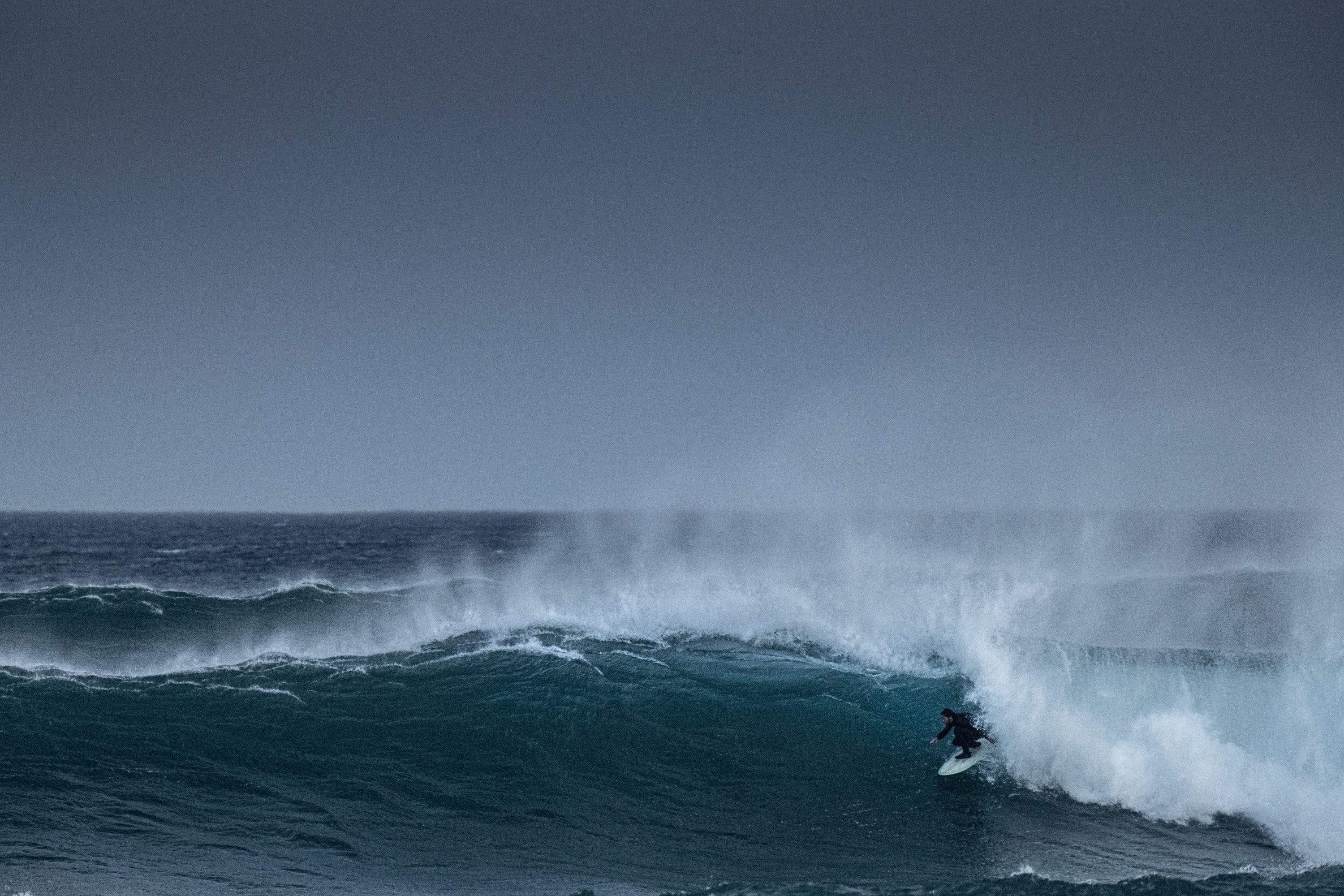
Not the same day, just Darcy Day, reading the textures of home.
Beyond it were offshore deeps and focusing reefs, drawing swells to concentrate their energy, at times with great force, particularly on this steep stretch that had a more sudden drop off – into deeper waters. Storm swells scoured and shaped the shore more aggressively, throwing up driftwoods and even sea life, creating a gathering place for all forms of life – including ours.
Gathering places provoke resting places, and resting places, over time, form their Spirits. The shell middens of Djaraak, as Bells was once called, and may again become, remind us of historic, and still real connections. New spirits of place have formed too, as more recent lifetimes of attachments embed themselves.
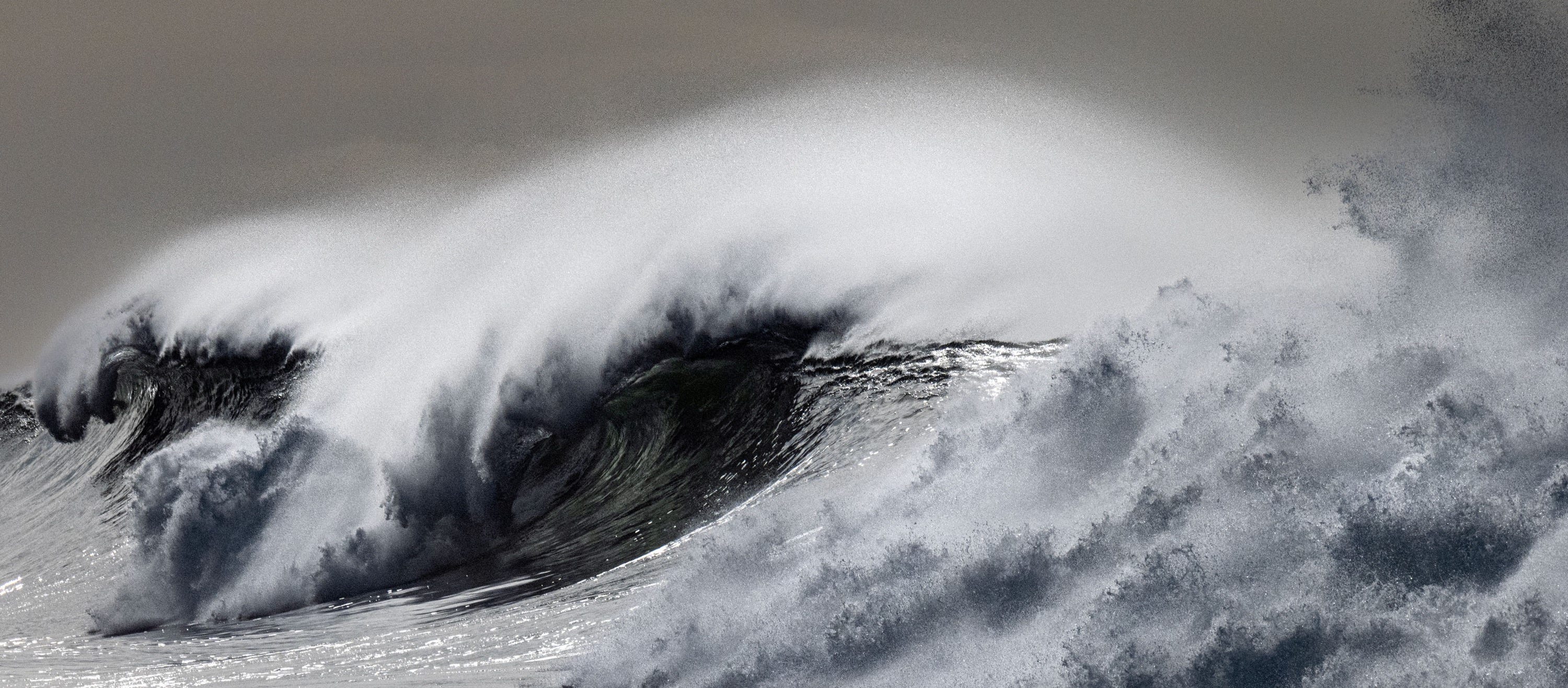
Periodically, someone will die here, either accidentally or as part of life’s cycle. Moments when ‘falling off your perch’ finds its truth when an elder quietly slips off a surfboard as death, that sneakiest of thieves, takes a moment to steal a life – halfway through a thought.
For those that remain, sitting out the back, sparing the odd moment to ponder these passings, there is little doubt that one would include the observation that this, or that, is ‘not a bad way, or place, to go’.
*4.3 billion years ago the Earth formed from its accretion disc whirling about the sun, gravity slowly attracting enough material to form a proto-Earth, which in turn drew in larger and larger objects. Some were water bearing, from the asteroid belt, or comets and more, from far out on the edges of interstellar space in the Kuiper Belt, and the mysterious Oort Cloud.
These are the sources that, the best evidence suggests, contributed to the waters that eventually birthed life, and our playground.
Thanks for that Mick. Happy new year to you.